

 Join AUS Squad


 Back To News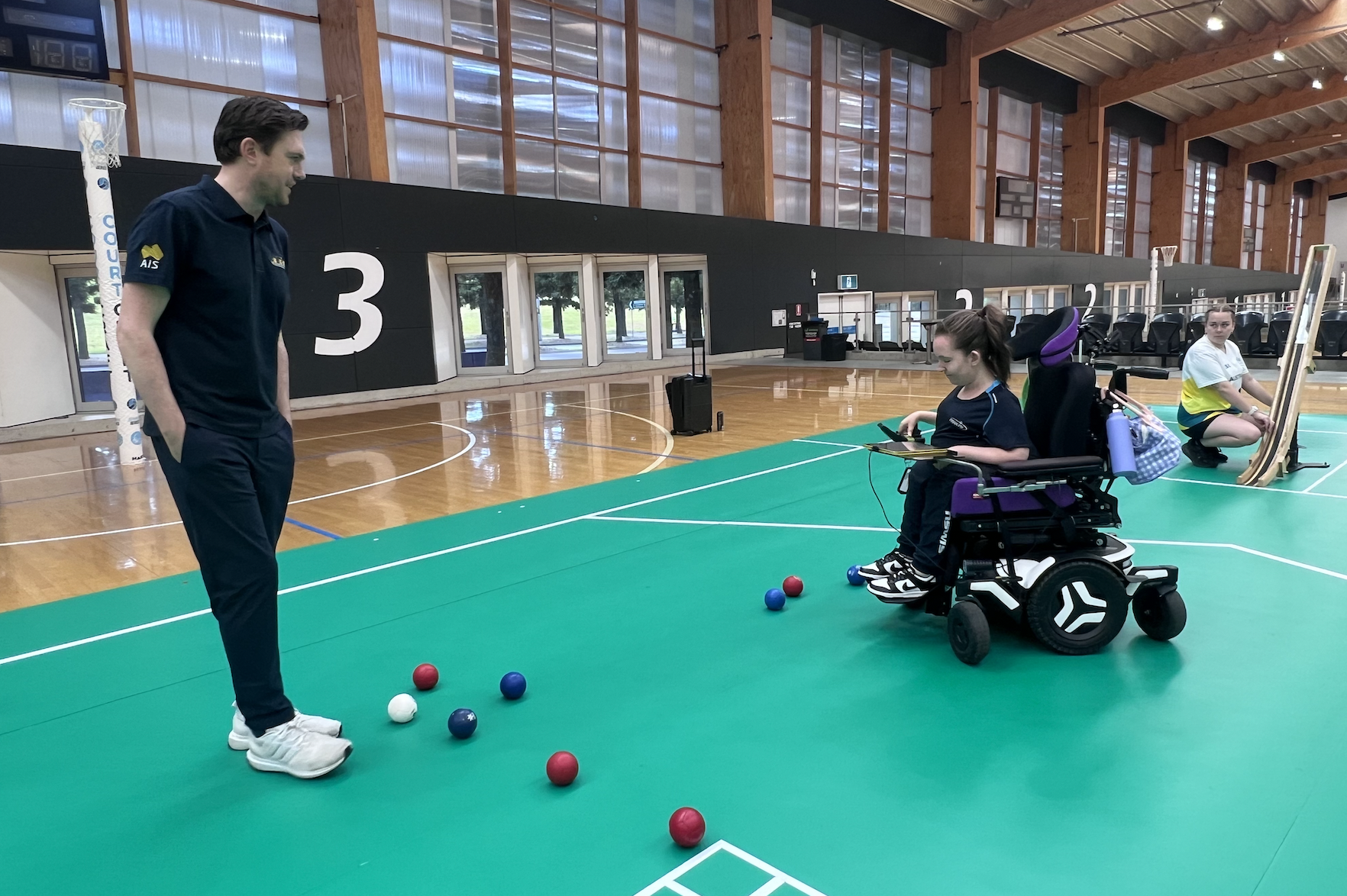
If Australia was to finally break through at LA2028 and claim an inaugural Paralympic gold medal in the fiercely competitive sport of boccia, it’s origins could be traced back to a thrilling game in round 15 of the 2016 AFL season.
At the Sydney Cricket Ground that chilly Saturday night, the Western Bulldogs conjured a nail-biting win over the high-flying Sydney Swans, scoring the winning goal with just four seconds left.
It set up the rest of the Bulldogs’ season. Three months later they beat Sydney again, this time in the grand final, to break the code’s longest existing premiership drought.
Standing at the back of the Bulldogs coaches’ box that season-defining night at the SCG was a young football analyst whose future work in the code would include various roles at Greater Western Sydney and Port Adelaide.
The analyst, Luke Kelly, is now the high performance coach at Boccia Australia, guiding Paralympic stars Dan Michel and Jamieson Leeson, and their ramp operators, and expanding the program on the way to Brisbane 2032.
Boccia – a precision sport played by throwing or rolling balls as close as possible to a white target ball – may seem an unusual destination for someone who spent more than a decade working in the AFL system. But it is symbolic of the calibre of talent being drawn into Para-sport through the Para System Uplift and the surprising synergies that rare experiences like Kelly’s find with Paralympic sports.
“Bevo had a great ability to build the players’ belief and confidence,” said Kelly, referring to his boss at the Western Bulldogs, head coach Luke Beveridge.
“They were such a young group, with some great experienced players like Bob Murphy, Matthew Boyd and these guys who were still leading the way.
“What I learnt there was that, if you continue to believe and give confidence to young people, there’s no timeline on when that jump (to success) can happen. That was the reality of that year.
“We had a game in the wet on the road against Sydney, which we won and it just took off from there. We made the finals, got on a great run and then you could just see the confidence and belief in these young guys, all on the same page: this is the program, this is our game plan.
“It was unbelievable the way it all came together.”
Kelly’s work in the AFL – which included data analysis, player development and coaching at VFL level – culminated with three years as assistant midfield coach at Port Adelaide until late last year.
Looking for a fresh start, he saw the boccia role advertised and it captured his interest.
“It ticked a lot of boxes; use of data, developing the high performance program, things like that,” he said.
“It was a well-rounded role and my footy experience is pretty well rounded, so it suited a lot of my experience and I was up for the challenge.”
Which is fortunate. Boccia is a highly technical sport, played globally by athletes who have significant physical impairments. Its nuances take years to learn and the athletes have unique requirements. The difference between success and failure is often measured in millimetres.
“The game itself is sort of like chess. There’s a lot of complexity to it. You talk to the top end athletes and they’re thinking two, three, four, five balls ahead. It’s unbelievable. So, they’ve been educating me a lot. The goal now is to take every athlete from where they are to where they want to be.”
Among them is Michel, two-time Paralympic medallist, 2022 world champion and current world No.1 in the men’s individual BC3 classification.
“It’s definitely an opportunity for a continuation of [long-time coach Ken Halliday] Ken’s legacy and a chance for us to take it to the next level,” Michel said.
“Luke’s come in with a real humble attitude, really keen to learn the sport and learn how he can fit in and help us be our best.
“It’s been a journey of two-way learning, I think. He has a lot of experience in other sports and high performance roles. He’s bringing that to boccia, which is such a technical sport, so there’s a lot for him to take in.
“He’s doing it really well, underpinned by that humility and a willingness to have a mindset that allows him to take in a much as he can. It’s been really good.”
Kelly – who started in March – said working with athletes with a disability was an opportunity to upend tried and tested ways of thinking about coaching
“We can all do a biomechanics degree and talk about power, leverage and all that. There are some basic fundamentals,” he said.
“But with these athletes, each of them is very different, so you have to think outside of what traditionally you would teach. You really have to get to know the athlete, inside out, and then start to talk about performance.
“With performance, they’ve each got their weapons and strengths, and our job is to maximise those. In footy, you spend a lot of time trying to lift the floor overall. Whereas here, it’s like, ‘No, they’re very good at this, so how do we take those strengths and get the maximum impact out of them?’
“That’s the main thing; understanding what they can do, where they are, and then maximising their abilities from there.”
Leeson, who won the silver medal in the women’s individual BC3 at Paris 2024, summed it up: “He’s pushing us and questioning us and finding those extra one percenters that we didn’t really know about yet.”
Recent results suggest the dynamic is working. At the World Boccia Cup in Seoul last month Michel and Leeson and their respective ramp assistants Ash Maddern and Jasmin Haydon won the pairs event, Australia’s first major title in over two years. Michel and Maddern also won silver in the BC3 male competition and Leeson and Haydon won bronze in the BC3 female event.
The team will be back in international competition at the Canberra 2025 World Boccia Challenger, starting on November 3 at the AIS.
“It’s a tough sport worldwide and we’re in the Asia region, the most competitive part of the world,” Kelly said.
“You’ve got teams like Korea and Thailand, which are really strong, Kazakhstan … countries that aren’t traditionally big in sport, but in this sport they are.
“I’m working with Dan and Jam who are number one and number five in the world. It’s relatively consistent but then you go to an international tournament and you realise this is a really high level sport. These guys are working on millimetres and setting up three or four balls ahead.
“My job is to clear every everything and make sure they’re at their absolute best when they get in the box. Because, once they’re in the box, they are on.”
It’s not the only aspect of boccia that has piqued Kelly’s passion.
“You’ve got to remember, even just for these guys to turn up at training, it’s not easy or straightforward,” he said.
“There’s a lot to organise, a lot of things to consider. There are life complications, there are carers to work with, transport considerations – it’s a genuine challenge.
“But they make it happen because they love the sport. It’s also social connection; it’s a way of life. That might be why there’s a real empathy, a real support for each other, even between nations.
“They’re talking and sharing ideas because they want to see everyone keep getting better.
“I haven’t really worked around disability before, but I’m finding that as long as you’re curious and you ask questions and you’re coming from the right place, they’ll explain what’s going on. That helps me to help them and takes away any hesitation.”
The Canberra 2025 World Boccia Challenger takes place at the AIS Arena from November 3 to 11.
By David Sygall, Paralympics Australia.
Published 27 October, 2025.


