

 Join AUS Squad


 On the night the Games ended, Brendan Flynn grabbed a bottle of wine and quietly stepped out of a function where singer Vanessa Amorosi was performing to a room full of Australian Paralympic and Olympic athletes.
The Paralympics Australia Chief Executive had just finished an epic stretch of work, which included being on the road for 100 of the 104 weekends leading up to the Paralympics. He was exhausted but elated.
“I took the bottle, went to a bus stop and poured a glass,” Flynn said.
“I sat there and thought to myself, ‘Oh my God, what have we just done?’
“I spent about an hour there reflecting on what had been achieved, what the athletes had achieved. It was amazing. It had been the best period of time in my working life, without a doubt.”
That’s saying something. Flynn had been involved in cycling and basketball at five Olympic Games before starting as Paralympics Australia’s General Manager of Sport in 1998 and advancing to CEO the following year. When the Paralympics Australia role first came up, he wanted to acquaint himself with what he was getting into.
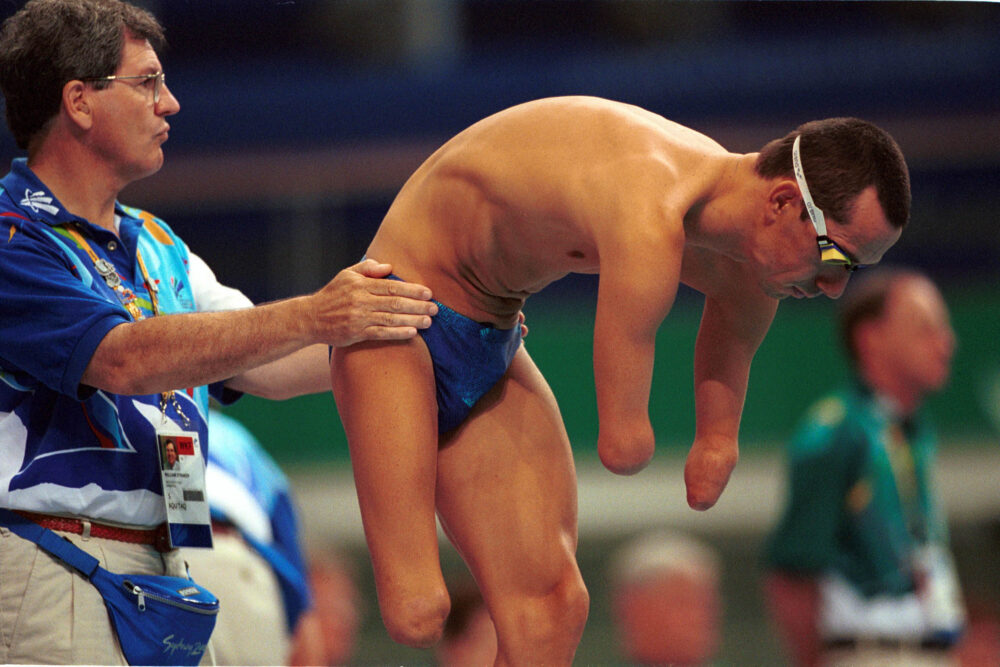
“I took a Paralympic athlete out for breakfast. I don’t want to mention his name, but he made me feel like a real idiot. He was a downhill skier, a Paralympic champion. He didn’t have any arms, but he chopped up his breakfast with his knife and fork. He was an accountant, had a wife and two kids … I was sold after that.”
Over the next two years, Flynn oversaw the final manic stretch of preparations for Australian Paralympic sport’s greatest opportunity. But, far from most of his previous experiences, much of it was done with the barest of resources.
When Flynn started, he said, there were fewer than 10 permanent staff at Paralympics Australia. What they did “was the work of 100 people”.
“Everyone was required to do a mammoth job,” he said. “We had very little money – the funding we received in those days compared to able-bodied sport was chalk and cheese – so I was constantly running around chasing sponsors, going to functions, making sure every training camp was well organised.
“We would talk to the athletes, talk to the managers, the coaches, the medical staff. We were very hands-on. We had to be. There was no choice. The small group of people who worked on this project really gave their lives up for the cause. And boy oh boy, were they good. These were people who would just about die for you.
“The results were on show in 2000. To get the team to that Opening Ceremony was an unbelievable amount of work. Those final two years were mayhem.”
Flynn had read the reports from Atlanta in 1996 and was stunned to discover that the athletes had been “treated like second class citizens”. He felt the only way was up and set about working with Chef de Mission Paul Bird and Assistant Chefs de Mission, including Robyn Smith and Tony Naar, to raise the standards of performance and, in turn, make sure the athletes were treated with respect.
“When I started, for instance, our wheelchair rugby team was awful,” Flynn said.
“The 1998 World Championships were in Canada; I went there with my coaching hat on and had to report back to the Board about what I thought.
“I sat through something like 50 games in five days, our team came last – they were a rabble – but I saw who I thought was the best coach in the world, a guy called Terry Vinyard, coaching the American team. I took Terry out to dinner, ploughed him with wine and beer and suggested he come to Australia and help our program.
“When I came back, I told the Board about the offer I’d made and they nearly killed me because I was going to spend money on coaches. But Terry said yes and the rest is history.
“The team was closely beaten for the gold in Sydney and since then, with supercoach Brad Dubberley, they play with immense pride and skill. That was the kind of thing we did with pretty much every sport.”
By David Sygall, Paralympics Australia.
Published 18 October, 2025.


