Join AUS Squad


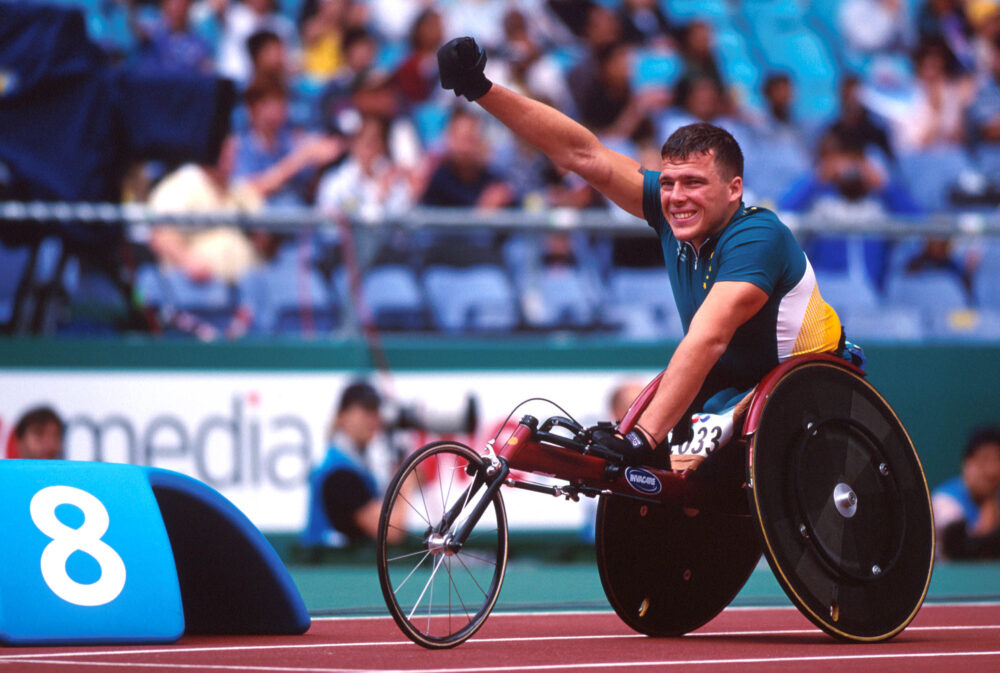 Well before Kurt Fearnley established himself as one of the nation’s greatest athletes, he humbly and excitedly began his Paralympic career in the midst of legends.
They were around him on the podium at his first Games and they were littered throughout Australia’s Sydney 2000 Para-athletics team.
“It was incredible to get a medal in the 800,” Fearnley said of his first Paralympic success, a silver in the 800 metres T54.
“I was on the podium with [Canada’s] Jeff Adams and [Mexico’s] Saúl Mendoza, who were legends of the sport. I wanted to get up on the podium at those Games, but it was all a big unknown for me. It was a challenging classification, a very challenging competition. I was 18 years old and you never really know how it’s going to go. You get kind of caught up in a whirlwind, seeing all these incredible athletes nail their sport.
“It never felt like it was real, getting that medal. But it was a moment that sprung me forward for the next 20 years.”
Australia won a world-beating 63 Para-athletics medals at the Sydney Games, more than half of them gold, to comfortably tally ahead of Great Britain and the United States. Fearnley won two silver medals.
Across the next four Paralympics, Fearnley would win a further 11 medals, including three gold. He also claimed multiple world championships, international marathons and Commonwealth Games triumphs. Away from competition, Fearnley established himself as a fierce advocate for people with disabilities, particularly through ambassadorships and board representation, including as Chair of the National Disability Insurance Agency, Australian Volunteers International and the Australian Day Council of NSW.
While Fearnley more closely resembled a kid in a lolly shop than a future star of Australian sport at Sydney, a large part of his future direction can be attributed to what he learnt during those 11 days and the months leading up to them.
“There was no pressure whatsoever for me at Sydney, it was just exciting. Everything felt so exciting. I was just a kid rolling with it,” he said.
“When you’re 18, at your first Games, you’re just bouncing from room to room and event to event. It’s just a blur.
“The key thing for me was that I was learning to be a Paralympian around people who expected more of themselves. I was part of an extremely driven team, an extremely professional team and you felt you were taking things to a different level.
“We were chock full of stars that had won at previous Games. They had lots of experience and success. It was such a big year. You had Neil Fuller, Amy Winters, Lou Sauvage, Greg Smith … there were so many gold medals among them, so many great athletes in our team, and I was just a young fella enjoying the whole thing.
“It was incredible, we were winning gold medals every day. Greg Smith won three, Louise won two or three, Tim Sullivan won a few, Neil won a couple, Tim Matthews … we had a massive number of athletes perform at their best at those Games. It’s impossible to replicate.”
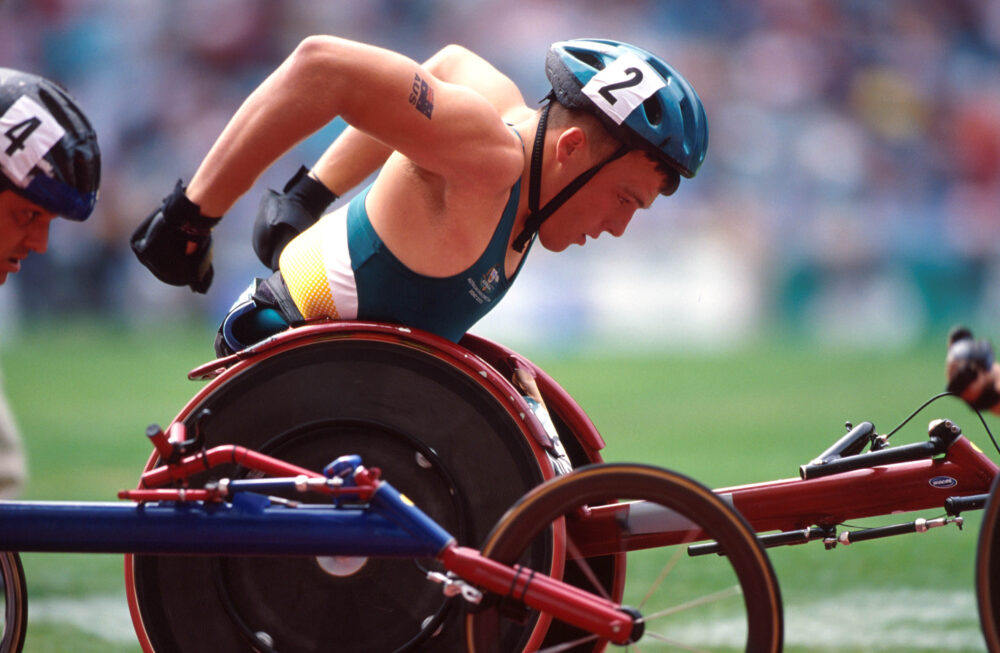 Beyond the quality of the athletes, Fearnley said a big reason for Australia’s success was the way the team and associated staff set about reaching its potential years before the Games.
“When we won the right to host the Paralympics, we ran with it,” he said.
“We developed a more professional team, a more professional outlook, our athletes were more committed to what it took to be a professional athlete. We probably jumped into it a couple of years before the rest of the world. We were definitely a bit ahead of the curve.
“In the six months leading up, there were team camps. I didn’t know any better, I’d never been to anything like it before, but I just remember thinking everyone knew those Games were coming up and everyone was holding each other to account.
“There was a really intense feel to the whole thing well before we even took to the track. Everyone was in the zone. Everyone knew we were going to have a lot of support and everyone knew we needed to be committed. There were a lot of our athletes who wanted that moment in front of their home crowd and to do really well.”
Fearnley is certain of the reasons for Australia’s Para-athletics success at Sydney 2000. However, he is less sure of the wider outcomes of those Games.
“It would have been good to have invested in surveys to find out what the Australian public thought of disability before and after the Games, so then we could really know if it was an inflection point,” he said.
“I know that the word ‘Paralympic’ meant more to the wider community in this country because we got further into the Australian sporting conscience. I think, especially for Australia, it did raise the profile of the Paralympic Movement and athletes with disabilities and gave a voice to a lot of strong advocates in different parts of the community.
“But, to say that we changed the lives of lots of people with disabilities, I don’t think we’re able to do that.
“We’re still here with train stations that aren’t accessible, buildings that aren’t accessible, shops that aren’t accessible, stadiums that have limited accessible seating – I don’t think we were really focusing on that at that time.
“What I do know is that the Games changed my world and was one of the most incredible experiences of my life.”
By David Sygall, Paralympics Australia.
Published 18 October, 2025.