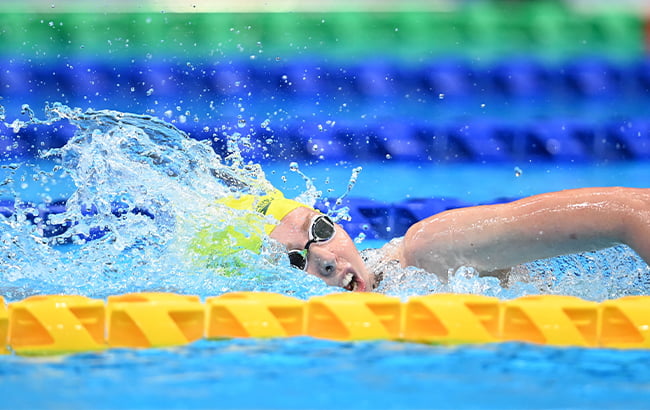
Swimming Australia is proud to announce the Australian Dolphins team to compete at the 2023 World Para Swimming Championships in Manchester, UK from 31 July to 6 August.
Following a sensational four days of competition at the Australian Swimming Championships at the Gold Coast Aquatic Centre, a 26 person team was announced last week.
The Australian Dolphins squad will feature Tokyo gold medalists including Rowan Crothers, Lakeisha Patterson, Benjamin Hance, and Rachael Watson.
Dual Paralympian Tim Hodge will be looking to defend his World Title in the 200m IM SM9, after breaking his own world record twice in one day.
Australian Dolphins star Tim Hodge broke his existing World Record again at the 2023 Australian Swimming Championships to claim Gold in the 200m Individual Medley Multi-Class Final. 🙌🌍🥇
— Australian Dolphins Swim Team (@DolphinsAUS) April 20, 2023
Tim Hodge shaved a massive 0.41 seconds off his previous world-best mark. 👏 pic.twitter.com/PnaXxLTBNi
Making their Australian Dolphins debut is 19 year old Poppy Wilson (Brisbane) and 21 year old Alexa Leary (Sunshine Coast).
Recently appointed Head Coaches of the Australian Dolphins Paralympic team, Kate Sparkes and Harley Connolly, are both excited for the depth of talent the team boasts for the World Championships.
Connolly said he’s very happy with the performances he’s seen from the squad at the Australian Championships.
“I’m really impressed with how the swimmers have shaped up and put their bodies on the line to get themselves on the Australian Team,” said Connolly.
“We have a really experienced team as well as two debutants which is exciting. Alex Leary has an amazing story, where following her accident she had while riding she managed to come back in a different sport and now will be able to challenge the world with her swimming. Poppy Wilson is another who has been an upcomer for years and finally broken through in the S10 Class and she’s going to be really competitive over the 400m freestyle and the 100m fly when we get to Worlds,” he said.
With just under 500 days to go until the Paris Paralympics, Connolly said the team is tracking well.
“Really excited on how the team is swimming, especially the upcomers who are just behind the guys who have made the team this year. It’s really exciting to see the young kids who are pushing the older ones up and it’s making everyone better.
“The team motto we have is ‘better people make a better team’ that’s really improving from everyone’s swimming,” he said.
Sparkes echoed Connolly’s comments, adding that the hard work starts now as they look to improve on results from this event building into the World Championships.
“This isn’t the finish line, this is the stepping stone of what we can do in the next few weeks,” said Sparkes.
“We now have two weeks until our next connection point when we’ll meet in Sydney for the Sydney Open, which will be the next time our team is together, and from there we will have eight weeks where we’ll want to see the team get back to work and it’s an opportunity to improve on their performances from the Australian Championships.
“We want to see people improve on their results from heats to finals but also from Trials to Manchester… so there is plenty of work ahead of us in the next 100 days,” he said.
With plenty of depth in the team Sparkes said there is a lot to be excited about and she said one to watch will be Tim Hodge.
“Tim Hodge is going to be the busiest swimmer at the meet competing in five individual events and potentially two relays… he’s definitely one to watch out for,” she said.
The 2023 World Para Swimming Championships will be held in Manchester, UK from 31 July to 6 August.
Australian Dolphins Team for the 2023 World Para Swimming Championships:
Jesse Aungles – Cruiz
Emily Beecroft – USC Spartans
Ricky Betar – Cruiz
Rowan Crothers – Yeronga Park
Katja Dedekind – Yeronga Park
Tom Gallagher – Sommerset
Jasmine Greenwood – Cruiz
Brenden Hall – USC Spartans
Ben Hance – St Andrews
Tim Hodge – ACU Blacktown
Jack Ireland – UQ
Ella Jones* – Kincumber
Jenna Jones – USC Spartans
Ahmed Kelly – Yarra Plenty
Alexa Leary – St Hildas
Paige Leonhardt – USC Spartans
Will Martin – Chandler
Madeleine McTernan – All Saints
Jake Michel – Carina
Lakeisha Patterson – USC Spartans
Col Pearse – Nunawading
Alex Saffy – Bunbury
Keira Stephens – Southport
Ruby Storm – St Andrews
Rachael Watson – Chandler
Poppy Wilson – Yeronga Park
*Subject to classification
Coaching Staff:
Kate Sparkes – Yeronga Park
Harley Connolly – USC Spartans
Casey Atkins – USC Spartans
Jon Bell – St Hildas
David Heyden – UQ Swim
Misha Payne – ACU Blacktown
Marty Roberts – ACT Performance Hub
Greg Towle – Swimming Australia
By: Swimming Australia
Posted: 26 April 2023

"*" indicates required fields