

 Join AUS Squad


 Back To News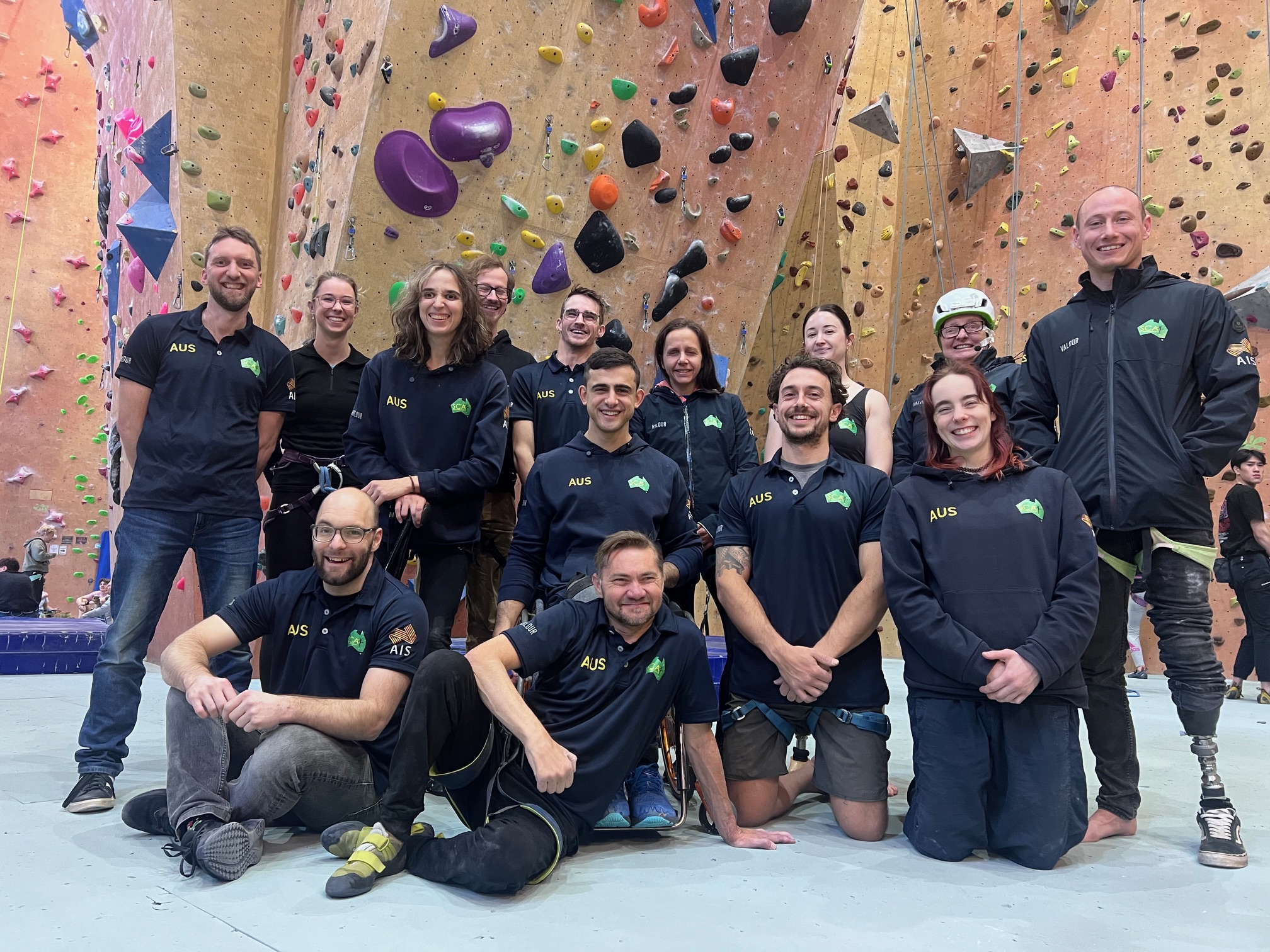
You could say Sarah Larcombe was climbing the walls hoping for her sport to be included at the Paralympic Games.
As the No.2-ranked Para-climber in the world in her AL2 classification and winner of nearly a dozen World Cup and World Championship medals, Larcombe was ready for the big stage. But there was only so much time, effort and money she felt she could invest while the sport’s future remained uncertain.
“Inclusion in the Paralympics is something I was really relying on because I’d already done three international seasons in the sport and it was pretty much all self-funded,” Larcombe said at a recent Australian team camp in Sydney.
“I was starting to feel burnt out because I’d been doing well, performing at a high level consistently, but doing that all on my own was really exhausting. I was feeling like, ‘I just don’t know if I can keep doing this without any extra support’.”
Had Para-climbing not been included on the LA 2028 Paralympic program, Larcombe said she would have quit competing.
“So, it was a huge relief. I know it’s going to open so many more doors for me and my teammates in terms of support and opportunities. It’s already made this year incredibly different and really exciting.”
It’s just the start. Since Para-climbing was confirmed by the International Paralympic Committee in June 2024 as the newest Paralympic sport, the program in Australia has been formalised, structured and tripled in size. Among the big changes so far, national coach Alex MacInnes went from volunteering across the able-bodied and Para programs to a paid role focusing solely on building the Para program.
MacInnes said the sport was expanding far and wide since the LA 2028 announcement, especially in the US, Japan and in several countries in Europe, where it has long been popular.
“The big piece for us is to identify new and emerging athletes to come into sport climbing,” MacInnes said.
“We can take an athlete on a pretty rapid trajectory to international performance. Obviously, the goal is to be to be chasing medals in LA and we definitely, I think, have athletes in the program currently who can achieve that.”
Among them is Glen Todd, whose classification is one of the four included for the Games. Over the past year or so, Todd has competed in the US, Austria and Italy and achieved results that have him on course for LA 2028. It all stemmed from his friend inviting him to come climbing one day about two-and-a-half years ago.
“I said yes, and I loved it,” said Todd, who has cerebral palsy.
“One week later I met some people from the Para-climbing community at the gym and straight away they encouraged me to climb more and to compete. It just went from there.”
Todd works as a landscape gardener and lives a fit and healthy lifestyle.
“I know how able I am and I think I can do everything. Nothing’s too hard,” he said.
“But I think climbing, for people with a disability, it gives us another dimension to move our bodies and to see what our bodies are capable of. It adds a new dimension to our lifestyles.
“I’m limited in some movement activities and this just gives me the challenge of working through a problem and achieving things with my body. It’s hard, but solving those problems and getting through them with my limitations is really satisfying.”
Todd is classified as an RP1 competitor, with RP standing for ‘range and power’ and the number a measure of the level of impairment, in this case ‘typically two or more limbs affected’.
Eight medal events will be contested at LA 2028, featuring 80 athletes: 40 men and 40 women.
The events are:
- Visually impaired: women’s B2 and men’s B1
- Upper limb deficiency: women’s and men’s AU2
- Lower limb deficiency: women’s and men’s AL2
- Range and power: women’s and men’s RP1
“I’m really keen to work towards LA ‘28. I love the active goal,” Todd said.
“I’m right up there to contend for a position and I’m just going to go for it over the next three years. I’m going to keep climbing, getting stronger, getting better and travelling the world.”
Larcombe has gone all-in as well. She was born with limb difference in her right leg, which was amputated when she was nine months old. She has used a prosthetic leg ever since.
“I think what made climbing really special for me as a disabled person was that it really showed me what my body and mind are capable of,” she said.
“It’s beyond what I thought was possible for me. I think we all have preconceived notions about what we can and can’t do, and that’s especially true for people with disabilities. But you would be surprised by what you can achieve on a climbing wall.
“That feeling of scaling a wall gives you a sense of freedom because the way that you move on the wall is completely different to how you move on the ground. I actually think I climb better than I walk.”
For Larcombe to achieve the ultimate goal at the Games, she’ll need to overcome France’s Lucie Jarrige, who dominates the women’s AL2 classification. But, with access now to performance services such as strength and conditioning, physiotherapy and sport psychology, she is confident she can beat her great rival.
“It’s been an absolute game changer for me. I’ve never experienced this kind of support before,” she said.
“There’s a lot of work to do, but I’m super motivated. In my mind I will be a part of the Paralympic team competing at LA and I will be on the podium. I could potentially win one of the first Para-climbing Paralympic medals ever for our country, which would be amazing.
“When I started climbing, I didn’t actually know there was a competitive side to it, so from the very beginning, I didn’t envision this kind of thing was possible. I started climbing because I thought it looked fun and because I was interested in climbing outdoors. Then I found the competitive side and I’ve loved every minute of it. I just love climbing so much, everything about it.”
That includes the variety within the sport and the people who do it.
“You can do it as a recreational activity, you can do it as a sport, you can do it outdoors,” she said.
“You can do it at any level and it’s so much fun. It’s not something that you necessarily have to be good at to really enjoy. It’s a very inclusive sport and even at a competition level, the breadth of disabilities we have within the competition is wide.
“I have my competition climbing and that’s really motivating for me. But I also love the community. People tend to start climbing because they think it looks cool and they stick around because of the people.”
The Australian team will get an idea of their progress when they contest the first benchmark event of the cycle, the World Championships in South Korea in September. Competition will be fierce, but coach MacInnes said the character of the community shone through at even the highest-pressure tournaments.
“The thing that attracted me to the sport in the first place was that it’s both a physical and mental challenge,” MacInnes said.
“There’s a problem-solving piece around the athlete being able to look at the holds on the wall and understand how they have to position themselves to move through it. That’s coupled, obviously, with a physical challenge. They have to pull off those movements and have the endurance to keep going.
“But I also love climbing as a community. It’s the only sport I’m aware of where you have athletes who are directly competing against each other talking to each other and explaining to each other how they’re going to do their climb. Because, at the end of the day, figuring out how to do it is only half the process. You then have to execute.”
That happens in uniquely different ways.
“I think one of the interesting ones is with the visually impaired classes where they have a sight guide on the ground,” he said. “In a major competition, you’ll often have an announcement that the crowd needs to be quiet so the athlete on the wall can hear that sight guide.
“You have these scenarios where you’ve got thousands of people in a crowd and you could hear a pin drop. The athlete gets to that high point and the place just erupts. I get goosebumps just thinking about it.”
The IFSC Para Climbing World Championships take place from September 20 to 25 in Seoul, South Korea.
By David Sygall, Paralympics Australia.
Published 28 July, 2025.


