Wheelchair Tennis
Sports Summary
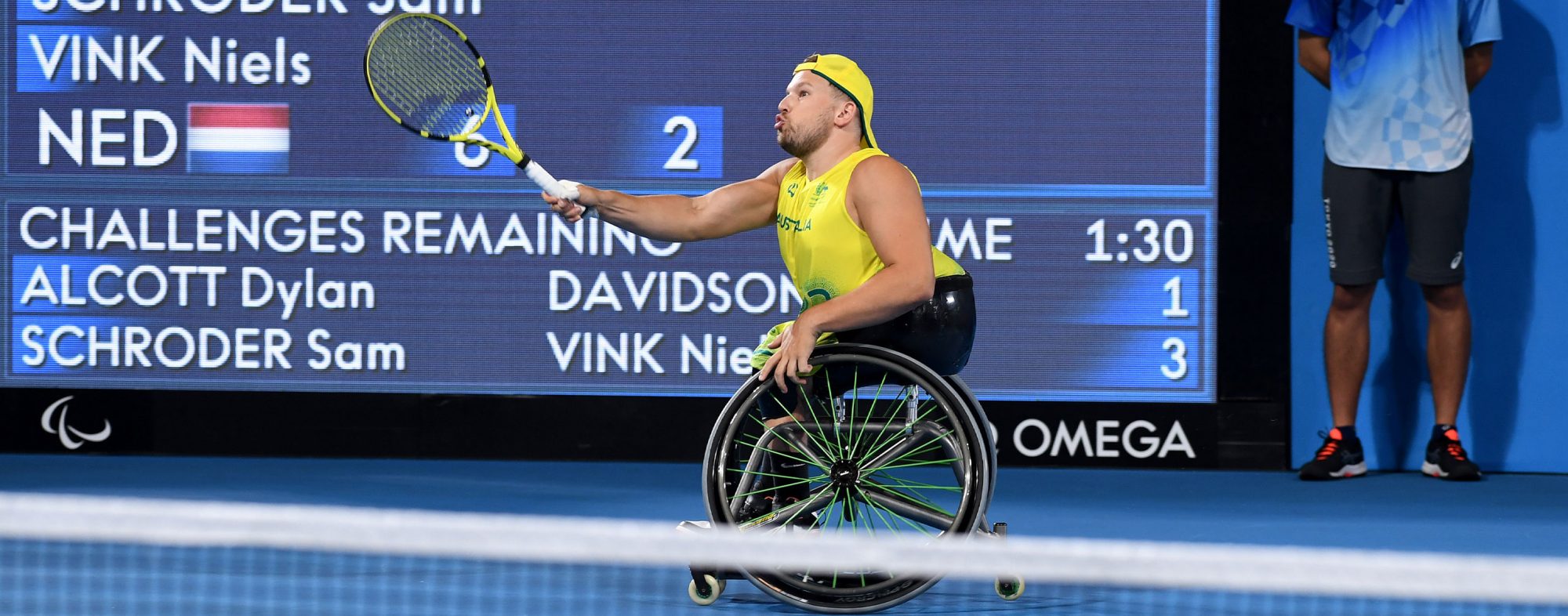
Wheelchair tennis appeared for the first time on the Paralympic Program in Barcelona in 1992. The game follows able-bodied tennis rules and athletes must have high levels of skill, fitness and strategy.
The only difference in wheelchair tennis competitions is that the ball is allowed to bounce twice - the first bounce being within the bounds of the court. Athletes must have a permanent substantial or total loss of function in one or both legs. For the quad division the eligibility criteria requires a player to have a disability in three or more limbs.
The events are singles (between two players) and doubles (between two pairs). The winner of a match is the first athlete or pair to win two sets.
Events/Disciplines
- Singles
- Doubles
Classification
Open Divison: Athletes with a physical disability. Players have a permanent substantial or total loss of function in one or both legs due to conditions such as spinal or nerve injury, limb loss / limb deficiency, joint fusion or other lower limb disability.
Quad Division: Athletes with a physical disability. Players have a impairment that impacts upon both upper and lower body, due to conditions such as spinal or nerve injury (quadriplegia), cerebral palsy or other similar disability
View a more detailed explanation of wheelchair tennis classification.
Rules & Equipment
Ball
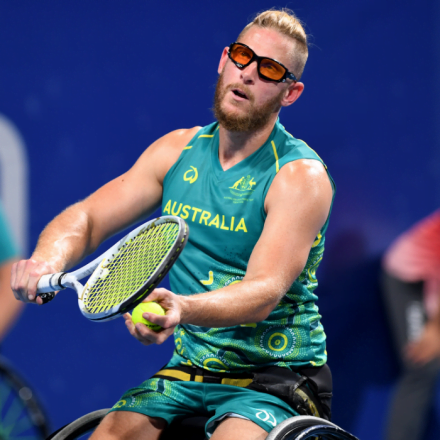
A ball is made of two elastic hemispheres joined together and covered by a layer of wool and synthetic threads. Its colour must be yellow or white.
Racket
The first tennis rackets were wooden and strings were made of ship or ewe bowels. Tennis rackets today are made of technologically advanced material such as graphite with strings made of synthetic threads. Wheelchair tennis athletes may have a special strap wound around their hand to help them hold the racket.
Wheelchair
A tennis wheelchair is lighter than usual. Speed and chair manoeuvrability are very important for wheelchair tennis and the chairs are constantly improved to meet these criteria.
Court
The court is a 23.77m x 8.23m rectangle for singles and a 23.77m x 10.97m rectangle for doubles. The same court can be marked for both singles and doubles. The court is divided into two halves by a net, which extends at a height of 0.914m at its centre and 1.07m at its sides. There are four types of courts – clay, grass, hard and carpet.
Links
International Tennis Federation
International Paralympic Committee