Powerlifting
Sports Summary
Powerlifting for athletes with a disability made its first appearance in 1964 at the second Paralympic Games in Tokyo as ‘Weightlifting’.
Later it changed from ‘Weightlifting’ to ‘Powerlifting’. The competition is open to all athletes with cerebral palsy, spinal injuries, short stature, amputees (lower limb amputees only) and les autres who meet minimal disability criteria.
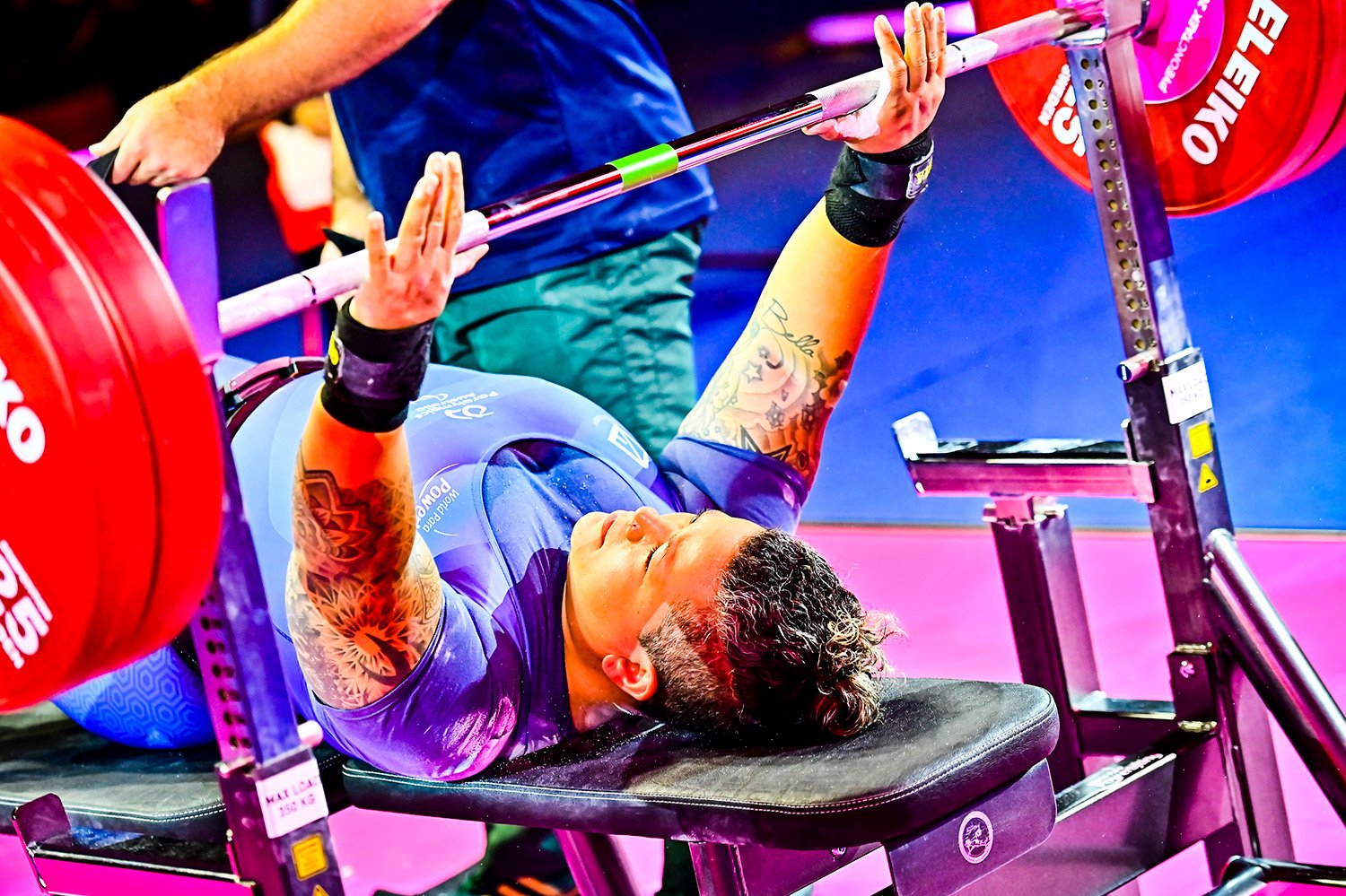
Powerlifting is the ultimate test of upper body strength. Competitors must lower the bar to the chest, hold it motionless on the chest and then press it upwards to arms length with locked elbows.
The bench press is the only discipline with 10 different categories based on body weight. The athletes are given three attempts and the winner is the athlete who lifts the highest number of kilograms.
Events/Disciplines
- Men’s competition is divided into 10 weight divisions, from 48kg to over 100kg
- Women’s competition is divided into 10 weight divisions, from 40kg to over 82.5kg
Classification
Classification
Athletes have to meet minimal disability criteria to be eligible for a classification in Powerlifting (as outlined by IPC Powerlifting).
Class - Eligible: Athletes with a physical disability. Athletes with limb loss or limb deficiency, cerebral palsy or acquired brain injury, spinal or nerve injury, short stature or other physical disability compete in one class.
View further resources below:
- Fact sheet detailing further information about powerlifting classification.
- The Australian classification masterlist for powerlifting.
Athletes who have been nationally or internationally classified as per IPC Classification Rules or APC Classification Policy are automatically included in this database. Information will be updated regularly.
Rules & Equipment
Discs
To have IPC Powerlifting approval, discs must conform as follows:
- All discs used in competition must weigh within 0.25% of their correct face value.
- The size of the hole in the middle of the disc may not exceed 53 mm or be less than 52mm.
- Discs must be within the following range: 1.25kg, 2.5kg, 5kg, 10kg, 15kg, 20kg and 25kg.
- For record purposes, lighter discs may be used to achieve a weight of a least 500 gr. more than the existing record.
- Discs must conform to the following colour code: 25kg = red, 20kg = blue, 15kg = yellow, 10kg and under = any colour.
- All discs must be clearly marked with their weight and loaded in the sequence of heavier discs innermost with the smaller discs in descending weight arranged so that the referees can read the weight on each disc.
- The first and heaviest disc loaded on the bar must be loaded face in, with the rest of the discs loaded face out.
- The diameter of the largest disc shall not be more than 450mm.
Collars
- A collar weighing 2.5kg must be worn by all athletes in competition.
The Bench
- Athletes compete lying on a bench. The official bench is 2.1m long. The main part of the bench is 61cm wide. At the end of the bench and towards the head, the bench narrows down to 30cm. The height of the bench varies between 45 and 50cm from the ground.