Boccia
Sports Summary
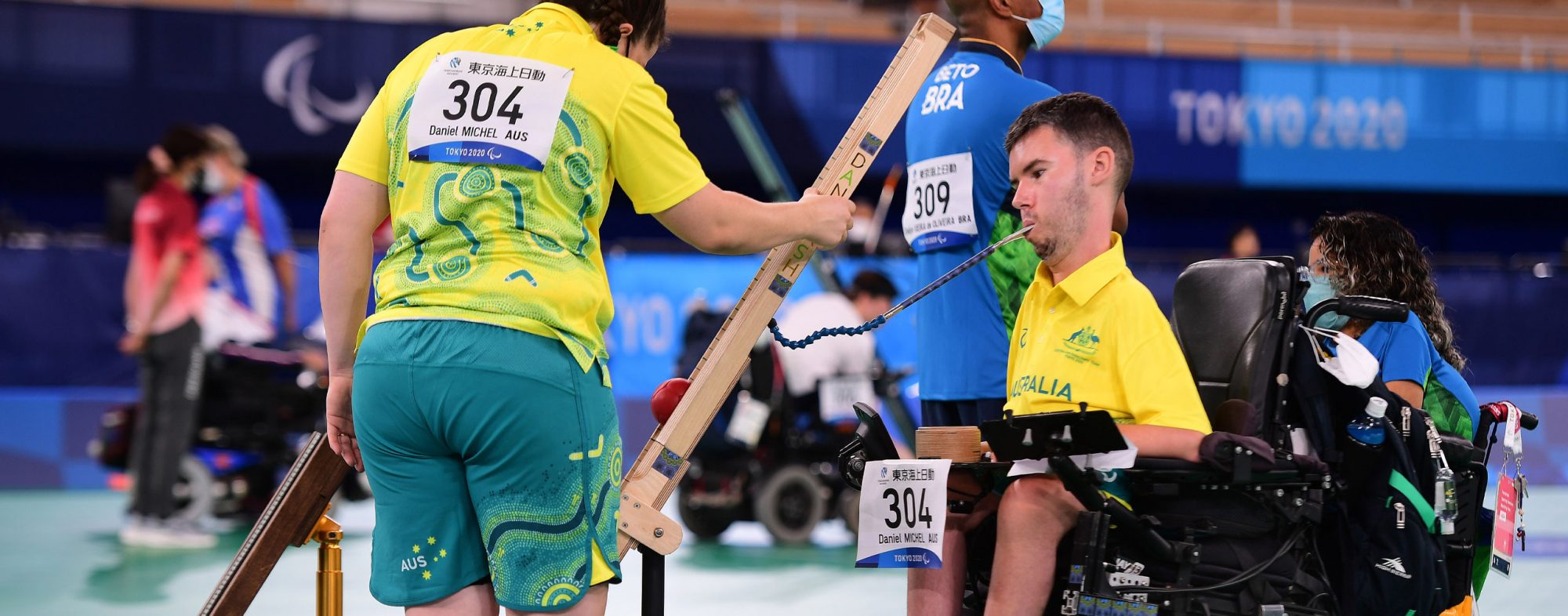
Making its debut as a Paralympic sport in 1992, boccia has ancient origins and tests each competitor’s degree of muscle control and accuracy. Competing in wheelchairs, cerebral palsy athletes throw, kick or use a chute device to propel leather balls as close as possible to a small white ball which serves as the jack (target). Players compete in team and individual events on an equal level.
Events/Disciplines
- Singles
- Teams
- Pairs
Classification
Players with cerebral palsy classified as CP1 or CP2 athletes (as defined in the CP-ISRA classification profiles) as well as athletes with other severe physical disabilities (eg, muscular dystrophy) are eligible to compete in Boccia.
Players are classified into four classes depending on their functional ability:
BC 1: For both CP1 throwers and CP2 foot players. Athletes may compete with the help of an assistant, who must remain outside the athlete's playing box. The assistant can only stabilise or adjust the playing chair and give a ball to the player on his/her request.
BC 2: For CP2 throwing players. Players are not eligible for assistance.
BC 3: For players with a very severe physical disability. Players use an assistive device and may be assisted by a person, who will remain in the player's box but who must keep his/her back to the court and eyes averted from play.
BC 4: For players with severe physical disabilities other than cerebral palsy. Players are not eligible for assistance.
View a more detailed explanation of boccia classification below.
View the Australian classification masterlist for boccia below.
These lists include all boccia athletes whose information is on file with the Australian Paralympic Committee. Information regarding athletes with an international classification has been obtained from the relevant International Federations. Athletes who have been nationally or internationally classified as per International or National Classification Policies and Procedures are automatically included in this database. Information will be updated regularly and compilation of accurate athlete classification data is still ongoing.
Rules & Equipment
Balls
Boccia balls are made of natural or synthetic leather and are slightly bigger than a tennis ball. Any ball will be accepted for play from any manufacturer providing they weigh 275gr (+/- 12gr) and measure 270mm in circumference (+/- 8mm). All balls will be checked at each competition. There are six red and six blue balls to indicate which team is playing and one white ball called the "jack".
The Court
The boccia court measures 12.5 x 6m with 2m of free space around it. The surface of the court is flat and smooth. The throwing area is divided into six rectangular throwing boxes. On the court is a V-shaped line over which balls must cross for the throw to be valid. A cross marks the position where the jack must be placed if it touches or crosses the boundary line or in the case of a tie break.
Dead Ball Container
Placed at the end of the court. A ball is 'dead' if it is thrown after the time limit, if it is thrown out of the competition court or if, during a throw, an athlete makes a rule violation.
Measuring Device
Used to accurately measure the distance of each ball from the jack.
Links
Boccia Australia
Cerebral Palsy International Sport and Recreation Association
International Paralympic Committee