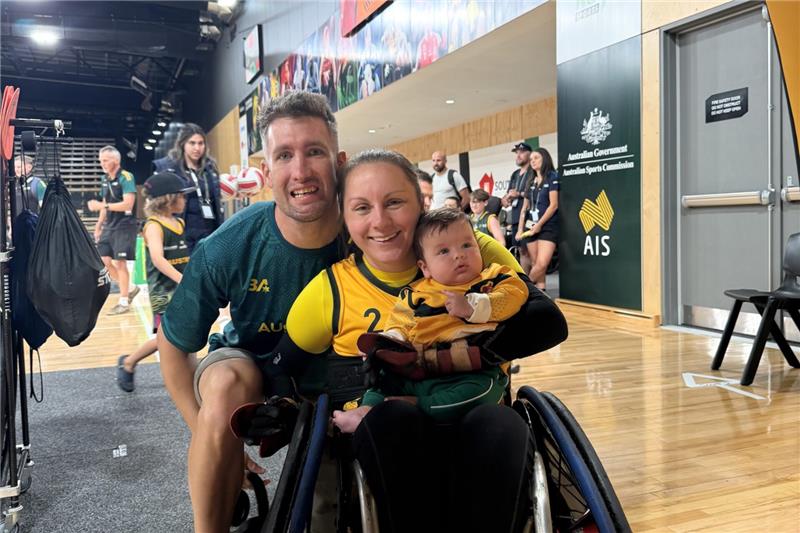
Eight months after giving birth to her daughter Billie, Ella Sabljak found herself back in one of the world’s most physically demanding sports – balancing elite competition with sleepless nights, feeding schedules and the unspoken guilt that can accompany stepping away from a baby to pursue high performance sport again.
The collision between motherhood and wheelchair rugby was never going to be simple.
For Sabljak, the return began with hesitation. Not about whether she still loved the sport, or whether her competitiveness would return, but whether her body – and mind – would allow her to step back into the intensity of elite contact sport after becoming a mother.
“I think I look at my body a lot differently now,” Sabljak said.
Not through the language of performance metrics or conditioning blocks, but through something less measurable – a recalibration of what strength means, and what her body is capable of beyond the court.
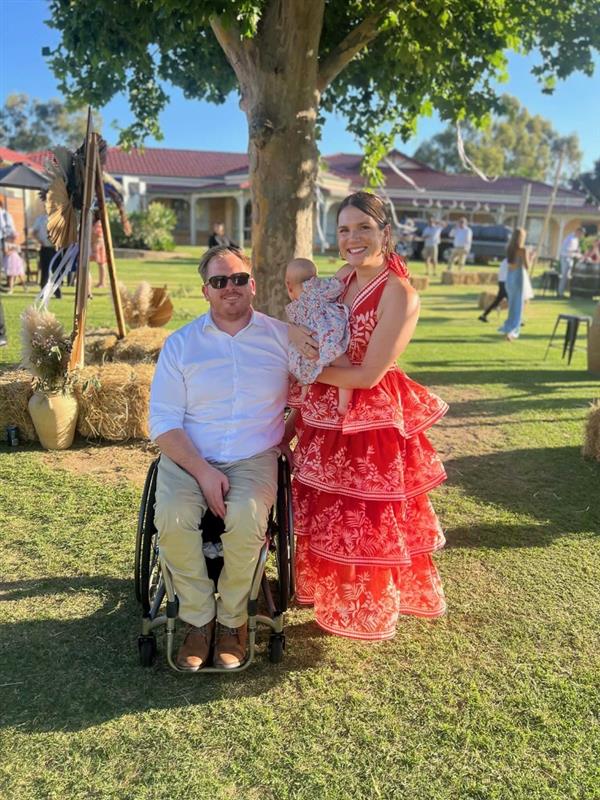
For fellow Steeler Emilie Miller, the path into parenthood looked entirely different. While continuing to train and compete at the highest level, Miller and her husband were privately navigating a long and emotional surrogacy journey that few around the team even knew was happening.
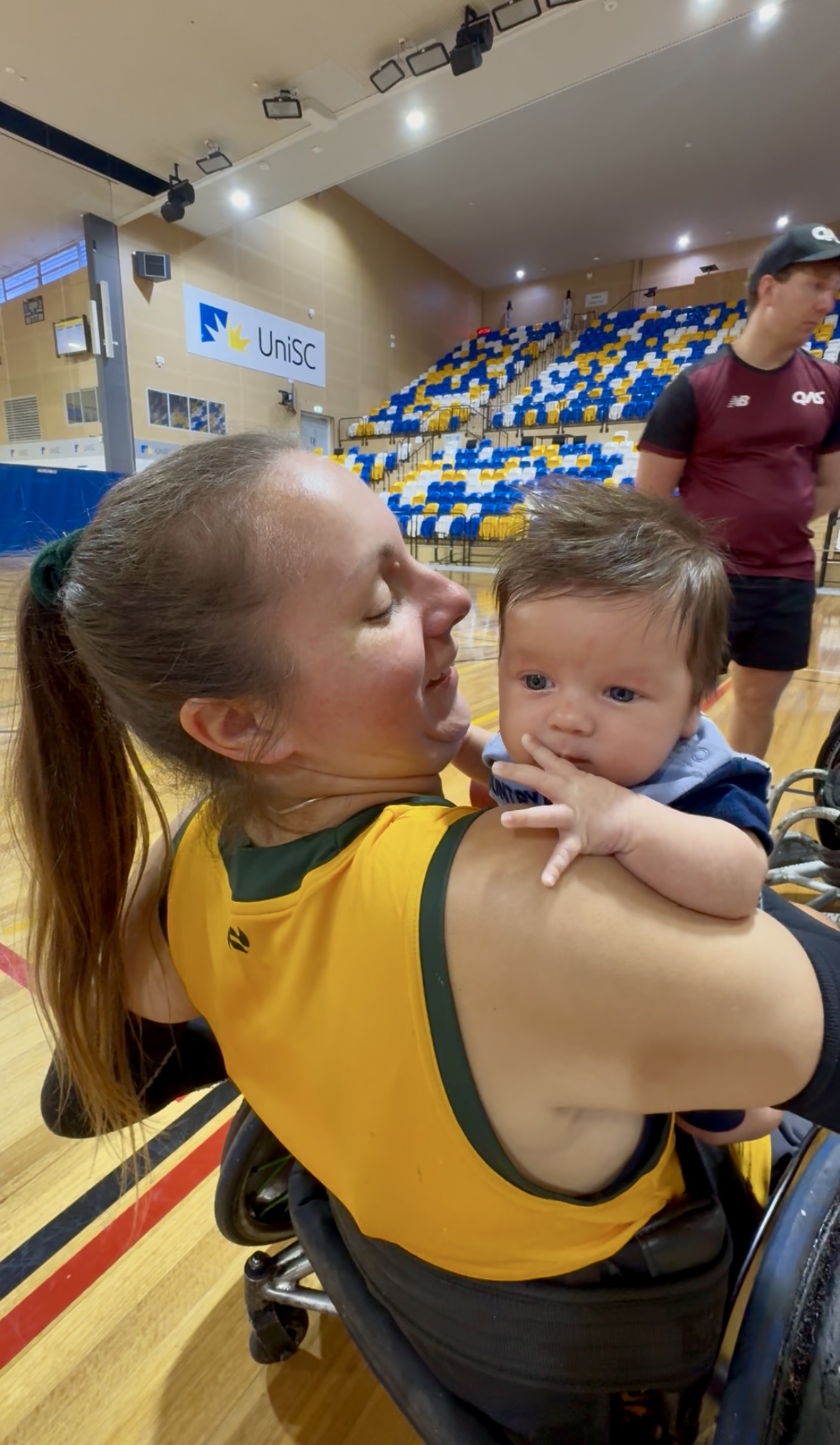
Two athletes. Two mothers. Two entirely different paths into parenthood.
Yet as the Australian Wheelchair Rugby team builds toward another World Championship campaign, both women are helping reshape what an elite sporting career can look like – one where motherhood is no longer positioned outside high performance sport, but increasingly alongside it.
Sabljak returned to competition earlier this year with the Queensland state team at the National Wheelchair Rugby Championships in Adelaide, helping guide the side to a dramatic title win in her first major tournament since Billie’s birth eight months earlier.
Pregnancy and postpartum recovery changed more than just her preparation.
“I’ve created this human. I’ve kept this human alive from my body, and I have so much more appreciation for what my body can do,” Sabljak said.
“I want to make sure that I’m strong and healthy so I can pick my daughter up off the floor and carry her around for a long time.”
Returning to one of the world’s most physically demanding Paralympic sports also brought new fears.
“There was probably a little bit of fear in the beginning,” she admitted.
“I don’t want to get hurt because I need to go home and hold, feed and care for my child.”
But as competition intensified, instinct slowly returned.
“I didn’t realise how much I missed playing until I was actually competing again,” she said.
“Then when I was out there, I just wanted to win. It unlocked that part of me that I hadn’t felt in almost two years.”
Off court, the realities of elite sport and early motherhood collided constantly. During the national championships, husband Matt spent the weekend walking laps of the Adelaide Showground with Billie strapped into a baby carrier, bringing her courtside between games and training sessions.
“My husband, Matt, was there with Billie full time over the weekend,” Sabljak said.
“He’d bring her to me at halftime or whenever I was off the court for a feed if she needed it, then strap her back into the baby carrier and walk laps so she’d sleep.”
Like many athlete mothers, Sabljak admits the emotional balance remains complicated.
“My first training session back in Brisbane, I was sitting there the whole time thinking, ‘Why am I here? Why am I not at home with my baby?’” she said.
“You feel that guilt of, ‘Am I being selfish in wanting to pursue this?’”
For Miller, the transition into motherhood followed a very different emotional and physical path.
More than two years ago, her cousin offered to become a surrogate after learning Miller and her husband hoped to start a family. What followed was a deeply personal journey that Miller largely kept private while continuing to compete internationally with the Steelers.
“Rugby became a grounding environment for me during an uncertain period in my life,” Miller said.
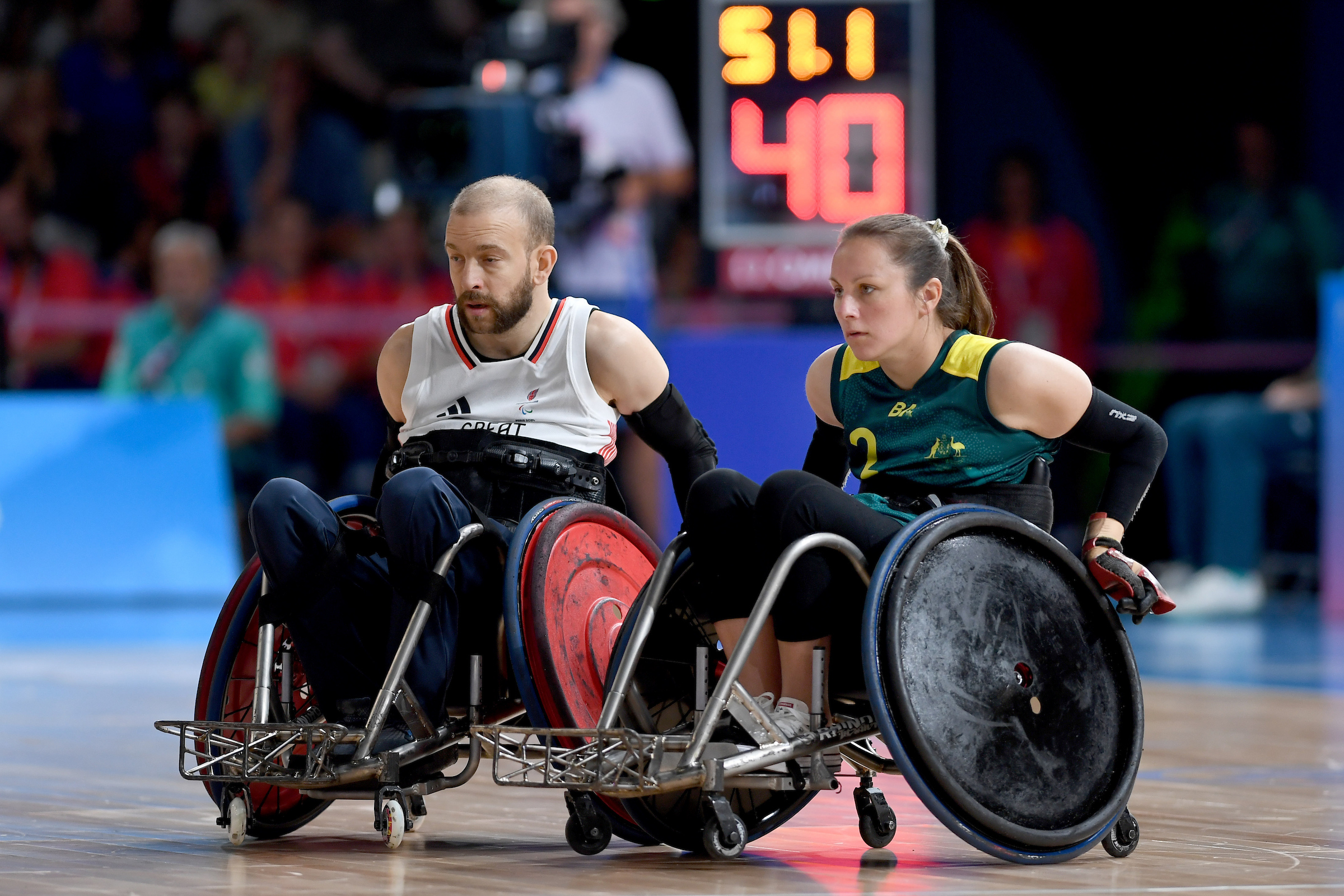
The timing of Max’s arrival created a moment of symmetry that still feels surreal.
“It was so special for me to have Max at the World Challenge in Adelaide as a full-circle moment,” she said.
“We found out we were going to become parents on the last day of that same tournament a year earlier.”
Unlike Sabljak, Miller did not experience pregnancy or postpartum recovery herself, but becoming a parent absolutelyreshaped every aspect of life inside a high performance environment.
Travelling to camps and competitions now involves support workers, detailed planning, disrupted sleep, increased physical load and the constant balancing act of caring for a baby alongside the demands of elite sport.
“A typical day in camp involves getting Max up and ready for the day, training, feeding and playing with him between sessions, putting him to bed, then team meetings and recovery,” she said.
“So, it’s a lot.”
“Since becoming a mum, I’ve learned that things don’t need to be perfect in order to perform well,” she said.
“I’ve learned to trust my ability to show up and perform even when things feel messy or imperfect.”
At the same time, motherhood has sharpened her ambition rather than softened it.
“I’m more driven and motivated each time I step onto the court because of the sacrifices involved,” she said.
“I want to set a strong example for my son and be someone he can be proud of one day.”
Queensland Head Coach and State Manager Ben Newton believes those experiences reflect a broader evolution occurring within wheelchair rugby’s high performance system.
“The most important things in that initial return period are flexibility and balance,” Newton said.
“Becoming a parent is a huge life change for anyone, and coaches need to support athletes in an individualised way to help navigate those changes.”
Newton said the sport continued to evolve as more women progressed through the high performance pathway while balancing parenthood and elite competition simultaneously.
“As they start families and decide what it means for their careers, we’ve all been learning to navigate it together,” he said.
That evolution was visible at the World Challenge in Adelaide, where four women took to the court for the Steelers – making up one-third of the squad in a sport long dominated by men.
For both Sabljak and Miller, the significance of that moment went beyond representation alone.
It reflected a sport beginning to create opportunities for athletes whose careers may no longer follow a straight line – whereparenthood is not treated as the end of elite ambition but part of the pathway itself.
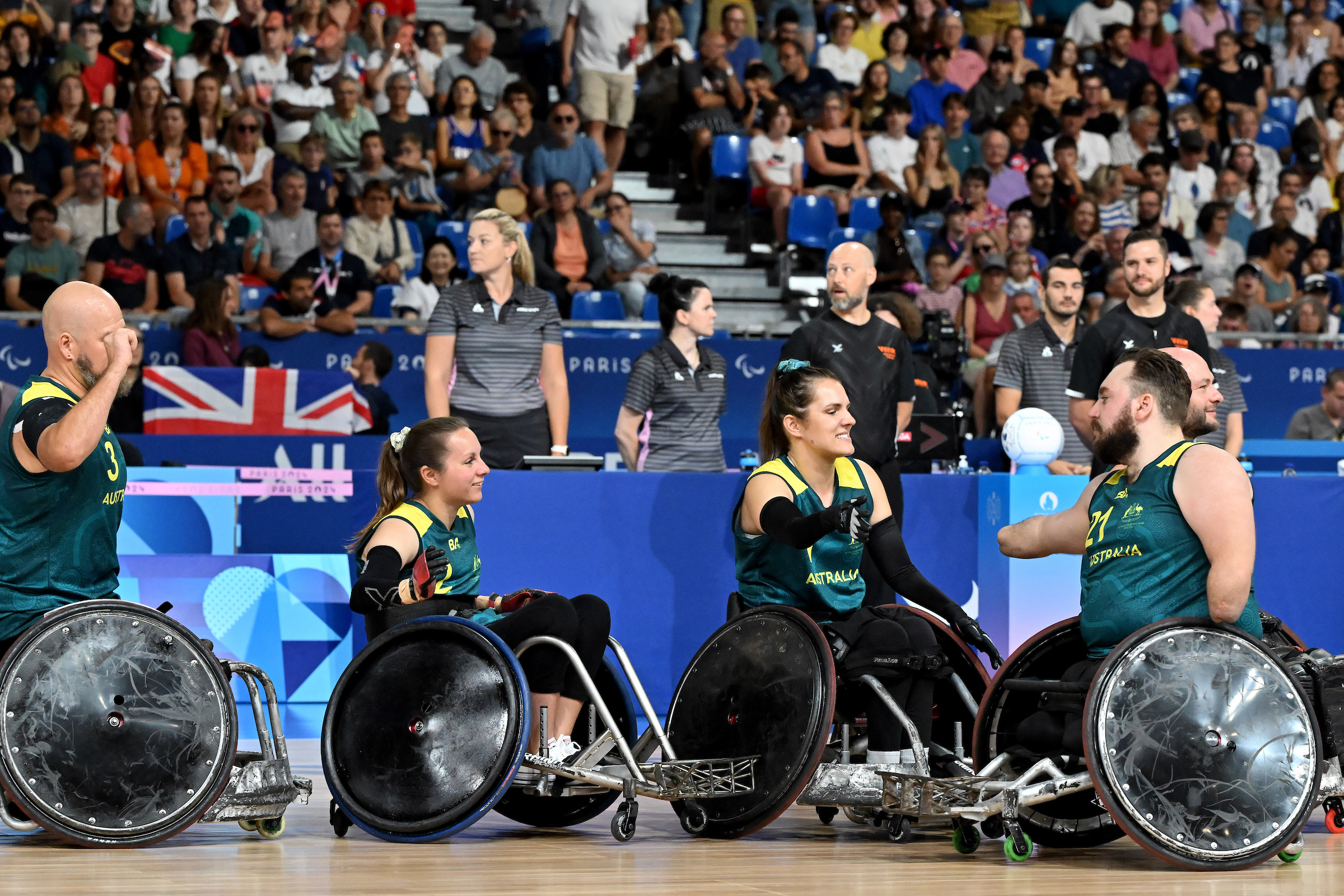
And for Sabljak, the reason for returning is now simpler than medals or selection.
“I really just want to show her what’s possible,” she said.
By Ashley Gillepsie, Paralympics Australia.
Published 8 May, 2026.

"*" indicates required fields