The white cane, although an almost universally recognised symbol of mobility for people with low vision, can mean very different things to different athletes who use them.
For Para-biathlete Taryn Dickens, it’s about confidence and independence. For goalball player Caitlin Hannen-Williams, the story is a little different.
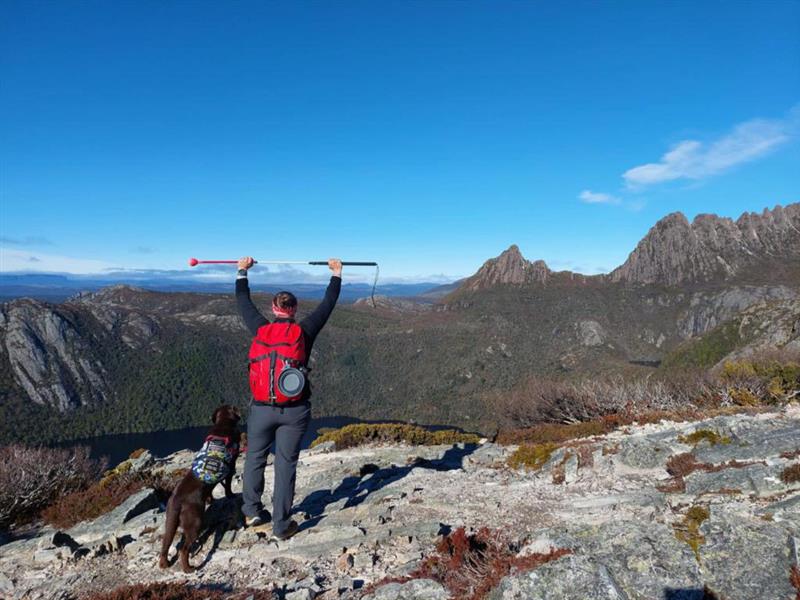
Dickens is on the road to the Milano Cortina 2026 Paralympic Winter Games. She transitioned to Para-sport to continue fuelling her fierce passion and drive, without the need to compare her performance to that of able-bodied counterparts.
She is also a vocal advocate for the use of a white cane and the possibilities it presents. International White Cane Day is on October 15.
“I have been diagnosed with cone-rod dystrophy, which is just another one of those retinal disorders that seems to give us tunnel vision and blurry vision,” Dickens said.
“I use my cane as much as I can … it just gave me independence back. I’ve been able to look up and I’ve been able to carry myself more confidently. I stand up straight and I feel like I can own the space that I’m in without feeling like I need to apologise to people all the time.
“I am still yet to work out a way to make it look cool to have a cane hanging off your belt,” she added jokingly.
Our Paralympians and Para-athletes often step into the shoes of advocates and educators – particularly in the lead up to a Paralympic Games – and Dickens said her cane had also become an avenue for discussion.
“I’m 43 years old and when I grew up, it was so shameful to ask people questions about their disabilities. But you can do it, just don’t be a jerk when you ask it, you know? Like, just ask because you’re genuinely curious.
“To me, using the cane is such a beautiful experience because so many people don’t get to understand what the world feels like around them … the amount that your other senses pick up because your eyesight’s deteriorating.”
It’s clear that nuance is key in the world of Para-sport. For Dickens, the use of a cane expands her confidence and independence, allowing her to train, travel, compete and achieve at an elite level – something that may not have been possible otherwise.
For goalball athlete Caitlin Hannen-Williams, the white cane represents something different. The 20-year-old is part of the Australian women’s goalball team, the Aussie Belles. At an international level, the fast-paced sport of goalball is played exclusively by athletes with low vision or blindness.
“I don’t use [my cane] very often because I have my guide dog and I prefer using her … I pretty much use my cane only when I’m travelling,” Hannen-Williams said.
The Perth-based athlete travels interstate and internationally to attend training camps and tournaments. She said she struggled with the social implications of using a cane in those contexts.
“I think the connotations around a cane don’t really appeal to me,” she said.
“There’s kind of negative connotations around people who use canes that [they] don’t know how to do things … They need people to help them, support them, do everything – and I don’t really feel that way. So, I don’t really love the image it gives me.
“Before they even get to know you as a person and as a strong, independent athlete, you feel almost like it can kind of undermine your own independence a little bit.”
Hannen-Williams is a Goalball Youth World Championship silver medallist, Australian national champion and is striving alongside her teammates for Los Angeles 2028 Paralympic Games selection. Alongside goalball, she has also competed in blind-cricket and is currently completing a film degree at Curtin University.
Though Hannen-Williams’ story differs from Dickens’, it is evident in both cases that the societal narrative around mobility aids permeates the way in which people use them – and it can be a deterrent for some users.
Hannen-Williams added: “For the right person, [canes] are definitely very beneficial, and they do give a lot of freedom to people who didn’t have that freedom before. A lot of independence as well, but it just depends on the person.”
Fans of Para-sport are more than likely to see a white cane or two on screens and in stadiums. Thanks to athletes like Dickens and Hannen-Williams, we get a first-hand look into the stories behind this widely recognised symbol, and the impacts it can have in the lives of our elite athletes.
By Zara Perry, Paralympics Australia.
Published 14 October, 2025.


"*" indicates required fields