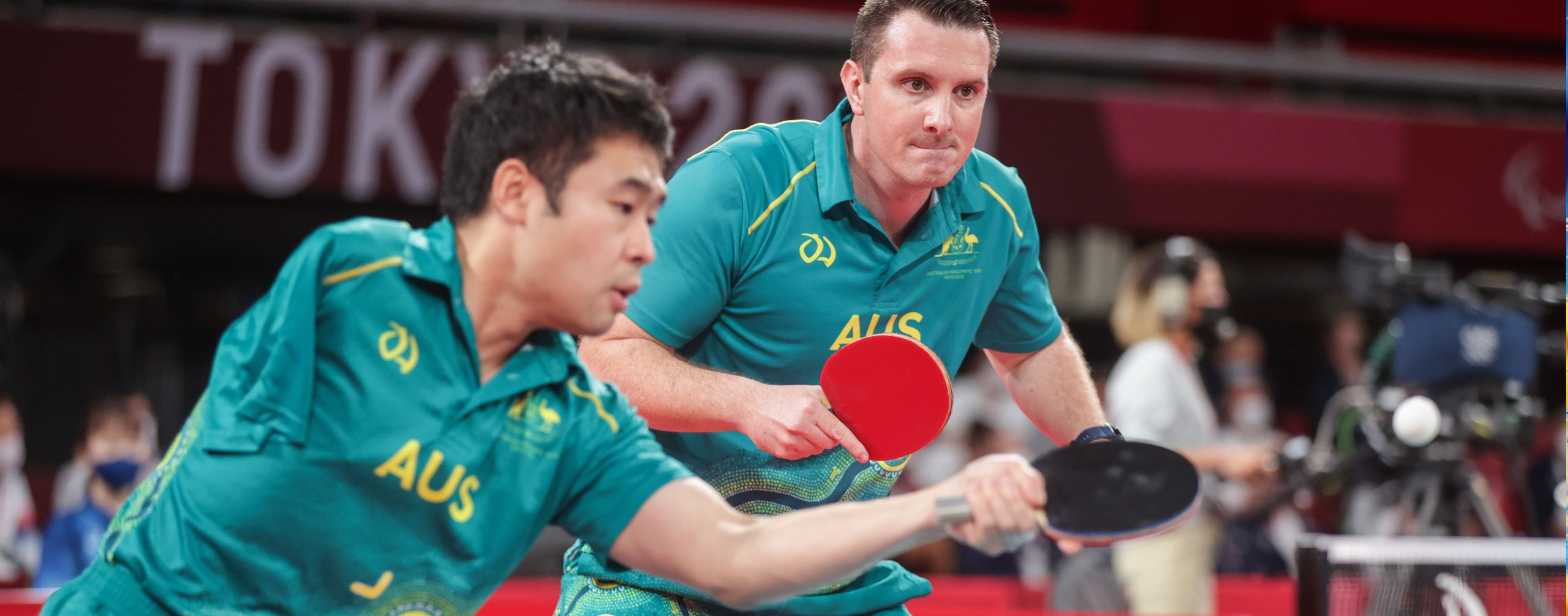


Table Tennis
Sports Summary
Table tennis was included in the first Paralympic Games in 1960. Athletes from all disability groups (with the exception of athletes with blindness/visual impairment) participate and compete in table tennis in standing and sitting (wheelchair) classes.
Click here to watch a video on Table Tennis
Men and women compete individually and in doubles, as well as in team events. A match comprises five sets of 11 points each and the winner is the player or pair winning three of the five sets.
The rules of the International Table Tennis Federation (ITTF) also apply to the Paralympic table tennis competitions with slight modifications regarding the serve rules for athletes competing in a wheelchair.
Events/Disciplines
- Individual event
- Team event
Classification
Classes 1 – 10: Athletes with a physical disability. Players in these classes have a physical disability such as limb loss or limb deficiency, cerebral palsy, or nerve / spinal cord damage. During classification, players are assessed on their range of movement, muscle strength, movement restrictions, balance in the wheelchair and the ability to handle the racquet. Players in classes 1 to 5 competing in wheelchairs, whilst players in classes 6 to 10 compete standing.
Class 11: Athletes with an intellectual disability.
View the resources below:
- Fact sheet detailing further information about table tennis classification.
- A link to the Australian classification masterlist for table tennis.
Australian Table Tennis Classification Masterlist
Athletes who have been nationally or internationally classified as per IPC / ITTF Classification Rules or APC Classification Policy are automatically included in the Masterlist. Information will be updated as classifications occur.
Rules & Equipment
Table
The table is 2.74 metres long, 1.525 metres wide and 76 centimetres high, while its surface must not be less than 20 centimetres thick. The competition surface is usually made from wood or synthetic materials.
Wheelchair friendly tables should have table legs at least 40 cm from the end line of the table for wheelchair players.
Net
The net is 15.25 centimetres high and extends along the width of the centre of the table, dividing it into two equal parts. The net is usually made of nylon and is coloured blue.
Ball
The ball has a 40mm diameter and weighs about 2.7 grams. It is made of celluloid or of similar plastic material. It is coloured white or mat orange.
Rackets
Since the 1950s, rackets have been covered by a layer of sponge-like material, which sits between a racquet's rubber surface and the wood, creating a new type of rubber layer. Using this material, new techniques of hitting and spinning the ball were discovered and developed, making the game more dynamic.
More information can be found on the following sites.
International Table Tennis Federation