The Australian Paralympic History Project aims to capture, manage and preserve the history of the Paralympic movement in Australia in a way that is relevant, accessible and places the Paralympic movement within its broader social context.

For the first 30 years of the Paralympic movement in Australia, there was no umbrella organisation responsible for the Australian Paralympic Team, until the Australian Paralympic Federation was established in 1990. It was renamed Australian Paralympic Committee in 1998 and Paralympics Australia in 2018.
As Paralympic sport in Australia continued to evolve, the connection between athletes and the history of their movement became less and less tangible. There were no mechanisms to celebrate the achievements of the past in the context of the present, so in 2010, Paralympics Australia established the Australian Paralympic History Project.
The Australian Paralympic History Project aims to capture, manage and preserve the history of the Paralympic movement in Australia in a way that is relevant, accessible and places the Paralympic movement within its broader social context.
The Australian Paralympic History Project commenced in 2010 with an approach to the National Library of Australia (NLA) to record the oral history of Kevin Coombs, an indigenous Paralympian from the first Paralympic Games in 1960. Under an agreement signed by Paralympics Australia and the NLA, 63 interviews were recorded (as of November 2018).
The oral histories tell the stories of people who have played a significant role in the development of Paralympic sport in Australia from the 1950s to the present, including the eight Paralympians who competed at the Rome 1960 Paralympic Games and were still alive in 2010.
Paralympics Australia has a collection of more than 40,000 images. Most images are from 1992 onward, but the collection from 1960 until 1992 is also growing as volunteers connect with early members of the Australian Paralympic Team.
Images with no monetary commercial value to Paralympics Australia are published via Wikimedia Commons. 3,079 images had been shared as of November 2018.
Paralympics Australia’s audio-visual collection includes footage from the Paralympic Games, interviews with athletes and sponsor advertisements.
The collection has been digitised from a range of media formats and is catalogued and stored at the National Sport Information Centre (NSIC).
Paralympics Australia holds scans of the scrapbooks of Ross Sutton and Daphne Hilton, Australia’s first Paralympic gold medallists, and other members of the Australian Paralympic Team.
From Australia’s first Paralympic gold medal and the bow and arrows used to win it, through to the uniforms of the 2018 Australian Paralympic Team, Paralympics Australia continues to assemble a collection of items of significance to the Paralympic movement in Australia.
Paralympics Australia works with the National Sports Museum to conserve and manage this collection. The collection is split between the Museum in Melbourne and an archive near our office in Sydney.
A unique collection of more than 1,300 catalogued items, including books, magazines, reports, submissions and proposals relating to Paralympics Australia, the Australian Paralympic Team, and Paralympic sport more broadly, is housed in the library in Paralympics Australia’s Sydney office.
The library is catalogued through the NSIC and Clearinghouse for Sport, with all items fully discoverable online. Subsequent access is controlled by Paralympics Australia.
Ongoing contact with alumni is a measure of the maturity of the Paralympic movement in Australia.
Birthdays and other key dates are regularly recognised by Paralympics Australia on social media, and face-to-face activities are held biannually to strengthen the relationship between Paralympic alumni and currently competing athletes.
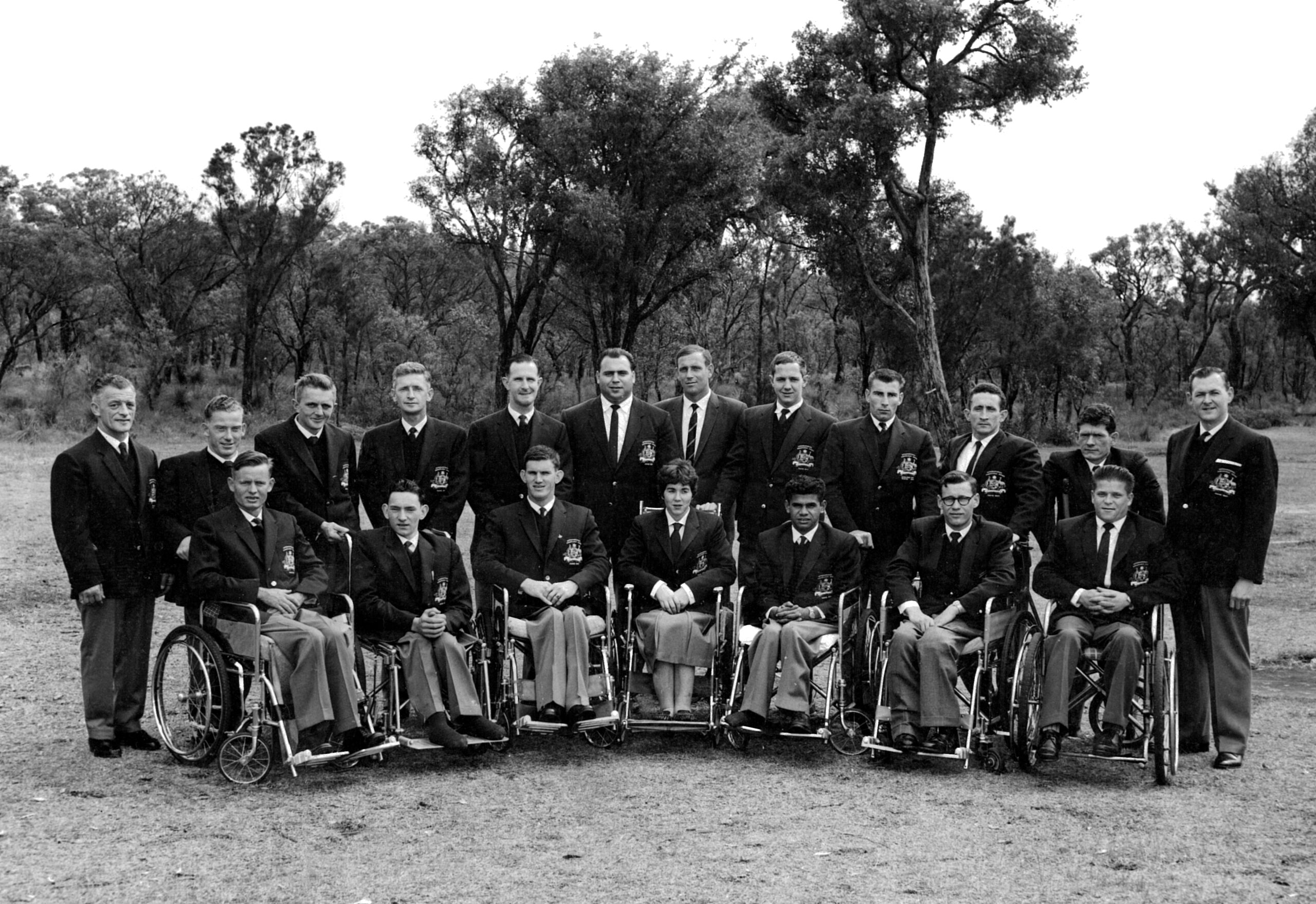
In 2010 and 2011, reunions were held for the 1960 and 1964 Australian Paralympic Teams.
The Australian Paralympic Hall of Fame was established in 2011 to recognise individuals who have:
Since 2010, Paralympics Australia has enjoyed a relationship with Wikimedia Australia, the parent body for Wikipedia in Australia.
Nearly 1,000 new articles relating to Paralympic sport, especially Paralympic sport in Australia, have been created, including articles about every Australian Paralympic medallist and every member of the Australian Paralympic Team from 2012 to 2018. During the Rio 2016 Paralympic Games, these articles were viewed more than 1.9 million times.
In 2017, more than 50 volunteer editors were involved in creating and updating Paralympic content. Paralympics Australia runs workshops annually for new and existing editors.
In 2009, Paralympics Australia established the Australian Centre for Paralympic Studies to: