Goalball
Sports Summary
Goalball is a sport exclusively for athletes who are blind or have a visual impairment. It was invented in 1946 in an effort to rehabilitate the blind veterans from World War II and made its Paralympic debut in 1976 in Toronto.
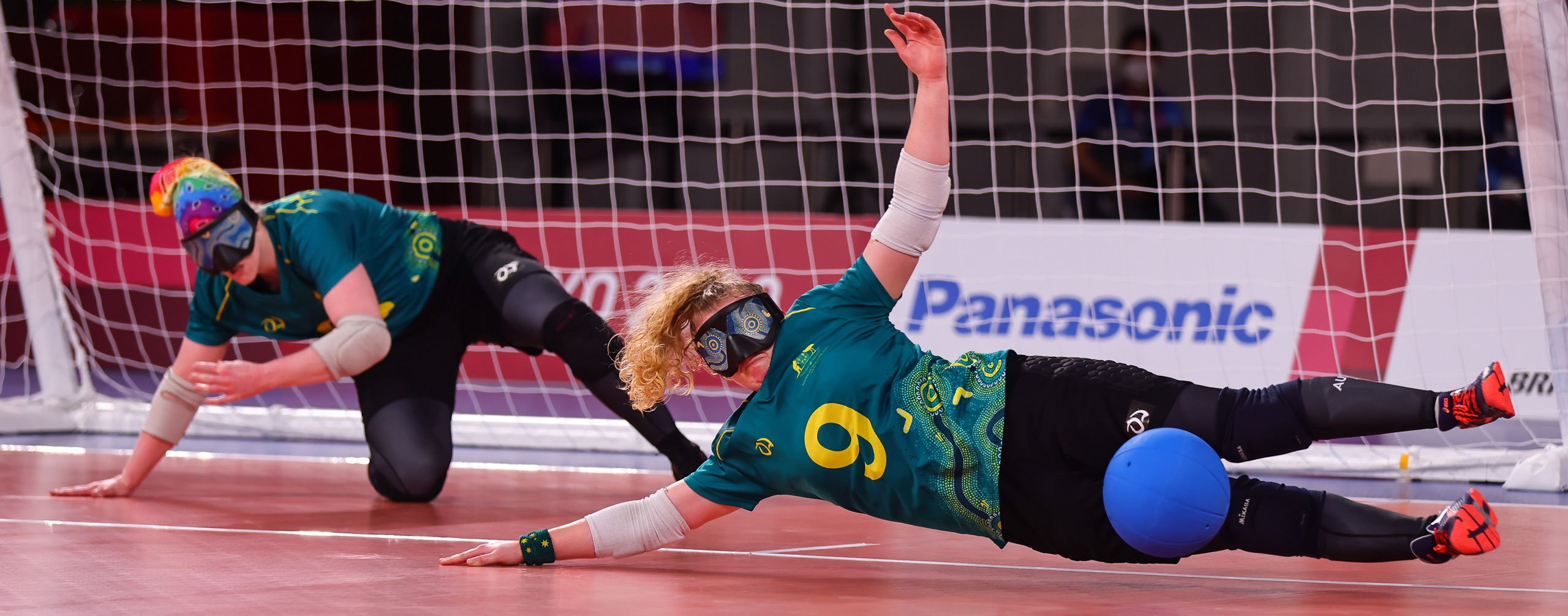
Goalball competitions are set apart from all other Paralympic events due to the unique atmosphere inside the playing venue. The object is to roll the ball into the opponent's goal while the opposing players try to block the ball with their bodies.
Bells inside the ball help to orientate the players by indicating the direction of the oncoming ball. Therefore, while play is in progress, complete silence is required in the venue to allow the players to concentrate and react instantly to the ball.
Goalball is played by male and female athletes with blindness/visual impairment and athletes wear ‘blackout’ masks on the playing court. This allows persons with varying degrees of vision to participate together. The game consists of two halves of 10 minutes each.
Events/Disciplines
Men's & Women's team events
Classification
Goalball is open to athletes with a visual impairment only:
B1: Total absence of perception of the light in both eyes, or some perception of the light but with inability to recognise the form of a hand at any distance and in any direction.
B2: From the ability to recognise the form of a hand to a visual acuity of 2/60 and/or a visual field of less than 5 degrees.
B3: From a visual acuity of above 2/60 to a visual acuity of 6/60 and/or a visual field or more than 5 degrees and less than 20 degrees.
All classifications must be made by measuring the best eye and to the highest possible correction. This means that all athletes who use contact lenses or correcting glasses normally, must wear them during classification, regardless of whether they intend to use them during competition.
View a more detailed explanation of Goalball classification.
View the Australian classification masterlist for goalball below.
These lists include all goalball athletes whose information is on file with the Australian Paralympic Committee. Information regarding athletes with an international classification has been obtained from the relevant International Federations. Athletes who have been nationally or internationally classified as per International or National Classification Policies and Procedures are automatically included in this database. Information will be updated regularly and compilation of accurate athlete classification data is still ongoing.
Rules & Equipment
Court
The court used for goalball is a rectangle 18 x 9m. Starting from the final lines, where the goalposts are placed, a 9 x 3m team area and a 9 x 3m landing area for each team is marked. The remaining 9 x 6m area, between the two landing areas, is called the neutral area, which is divided in two parts by the centre line. With the exception of the final lines, all markings are tactile to enable the players' orientation. This includes the players' position and orientation lines in each team area. Goalposts have a height and length of 1.3m and 9m respectively. The court markings are clearly visible and tactile to help players orientate themselves on court.
Goals
Regulation goals measure 9 (equal to the length of the court) x 1.3m high.
Ball
The ball used for goalball competition is made of rubber, weighs 1.25kg with a circumference of approximately 76cm. It has eight holes with noise bells inside. The ball must meet the specifications of the IBSA Sport Technical Committee.
Clothing
Teams must wear matching jerseys, pants and socks with a number clearly visible on the front and back of each player.
Eyeshades
All competitors must wear eyeshades at all times on the court. At all major competitions, all players have their eyes covered by gauze patches under the supervision of the IBSA Goalball Technical Delegate. Penalties are given if a player touches the eyeshade during play. This ensures that the level of all players is equal.
Links
Australian Goalball Association
Blind Sports Australia
International Blind Sport Association
International Paralympic Committee